Writing software that works is not the same as writing software that can be verified, maintained, integrated, and defended under formal review. In regulated and high-assurance environments, architecture decisions made early shape everything that follows: requirements traceability, interface clarity, integration stability, structural coverage strategy, and the overall certifiability of the system. SafeCode Consulting provides software engineering and design support for organizations that need implementation capability grounded in disciplined engineering from the outset, not retrofitted after problems appear. Quality, safety, and security are not readily added software features.
In regulated software development, requirements are not optional paperwork. They are the engineering foundation that makes design, implementation, verification, and certification evidence defensible. Yet many programs still treat requirements as something to write after the software exists, or as a partial artifact that can be patched later when questions arise. In high-assurance work, that approach is one of the fastest paths to late-cycle defects, integration failures, and audit findings.
Testing is essential, but it is not always enough. Some behaviors are difficult to test exhaustively. Some defects hide in interactions, edge conditions, timing dependencies, or tool-generated artifacts that ordinary test execution will not expose. In high-assurance development, strong verification depends not only on executing tests, but on knowing where analysis, review, and targeted technical assurance are needed to close the gaps that testing alone leaves behind.
Certification is not a final hurdle at the end of development. It is an engineering and program discipline that runs through the entire lifecycle: requirements, architecture, process definition, tooling, evidence generation, review preparation, and audit response. Programs run into difficulty when certification is treated as a paperwork phase instead of a design constraint, or when teams move forward on assumptions about what a standard requires without testing those assumptions carefully enough.
Face each Stage of Involvement knowing what the reviewers will find — because you found it first.
Every DO-178C program faces Stage of Involvement reviews, in which the certification authority or its designees examine the program's plans, data, and evidence at defined points in the lifecycle. Each SOI samples specific artifacts. Each is scheduled well in advance. Which means each one can be prepared for — deliberately, not frantically.
Budget once. Schedule when it matters.
The moment a program most needs outside review is rarely the moment procurement is easiest. An audit gets announced. An integration problem surfaces. A design decision needs experienced independent judgment before it hardens into the architecture. When that moment arrives, the last thing you want standing between the question and the answer is a new purchase order.
The Reserved Review Bundle lets you set aside review capacity while budget is available — and schedule it when your program actually needs it.
One scheduled day each quarter. A different lens each visit.
Safety-critical programs rarely fail at milestones. They drift between them. Requirements and
code separate quietly. Coverage assumptions age. Interfaces accumulate undocumented behavior.
By the time a formal review makes the drift visible, it has usually been compounding for months.
Strengthen the architecture before structural problems spread downstream.
SafeCode’s Architecture Assessment provides a focused review of software architecture and detailed design decisions with attention to structure, interfaces, initialization behavior, partitioning, verification impact, and certifiability.
Know what your evidence will look like before someone else tells you.
SafeCode’s Evidence Package Review provides a focused assessment of certification evidence for completeness, consistency, defensibility, and alignment with the applicable objectives.
Clarify what the standard requires before effort goes in the wrong direction.
SafeCode’s Standards Interpretation Brief helps organizations resolve ambiguous, disputed, or high-impact questions about standards, objectives, and compliance expectations in a specific program context.
Assess submission readiness before the real review begins.
SafeCode’s Pre-Submission Review gives teams an experienced outside check on whether a submission, audit package, or milestone review set is ready for external scrutiny.
Make traceability defensible by fixing the model behind the links.
SafeCode’s Traceability Model Assessment reviews how requirements, design, code, interfaces, and verification evidence are intended to connect, and identifies where the structure is too weak, inconsistent, or ambiguous to support assurance.
Align verification effort with the risks that actually matter.
SafeCode’s Verification Strategy Review assesses whether the planned verification approach is technically sound, proportionate to the software’s assurance needs, and likely to produce evidence that will hold up under scrutiny.
Bring experienced outside scrutiny to the moments that matter most.
SafeCode’s Independent Technical Review provides a focused, defined-scope assessment of code, design, architecture, interfaces, or review readiness at a critical milestone. It helps organizations surface material risks, challenge weak assumptions, and strengthen decision-making before formal reviews, customer exposure, or downstream rework.
Clarify what must be justified when your compiler matters to the assurance case.
SafeCode’s Compiler Analysis and Qualification Report provides a focused review of compiler usage, behavior assumptions, and qualification or validation needs so your program can make defensible decisions about tool trust in a regulated environment.
Build the process basis before weak foundations become expensive problems.
SafeCode’s Process Architecture Package helps organizations define, refine, or repair the plans, standards, checklists, and supporting framework needed to support a credible certification or compliance path from the start.
Know where your program stands before formal review begins
SafeCode’s Certification Readiness Assessment provides a structured review of your program’s certification posture across process, planning, selected artifacts, tooling assumptions, and evidence readiness. It is designed for organizations that need a broad, objective view of where they stand against the applicable standard before formal review, major commitment, or deeper remediation work begins.
A focused review of an active embedded software architecture to identify structural weaknesses, interface risks, and design assumptions that may be increasing integration, verification, or certification difficulty.
A targeted review of an in-progress software effort to identify important gaps in engineering discipline, traceability, verification support, documentation, and process alignment before those weaknesses become significantly more expensive to correct.
A focused review of whether an in-progress software effort appears to be staying aligned with its certification or compliance objectives, with particular attention to lifecycle assumptions, evidence direction, and issues that may create avoidable trouble later.
A focused workshop for active software programs that need to identify recurring quality risks and the engineering, verification, or process patterns behind them before they produce larger failures.

The Implementation can be Right, and Still be Wrong
Sometimes the key to a solution lies in discovering the questions that have not yet been asked. A large multinational corporation developing a crucial piece of a new DoD system was stymied. Even with their huge team of experts, they had been unable to resolve a technical issue. They had the skills and technical acumen, but needed a fresh perspective.

A New Trick Can Save the Day
Medical device manufacturers face a steep regulatory burden. Even the least critical medical systems must receive FDA approval before they can be placed on the market. This Fortune 500 medical device manufacturer was preparing to ship an important, but low-risk upgrade to a stalwart family of institutional medical equipment. Then at the last minute, the program hit a wall – at least it looked that way.

The Dreaded Do-over
It can be hard to discard work that came at a high cost. Sometimes fixing poorly written software is the costliest path. Sometimes the right move is just to start over.

Keep Calm and Carry on
Generally, market forces evolve over time. Sometimes they are altered overnight by events outside anyone’s control. When that happens, organizations do not just need speed. They need people who can integrate quickly, work across boundaries, and help keep important work disciplined while the pace changes around them.
I have a challenge for you.
I contend that I can take a moderate-sized software unit, say 5,000 to 10,000 lines of code, from conception through verification at least twice as quickly as the most productive developer on your team.
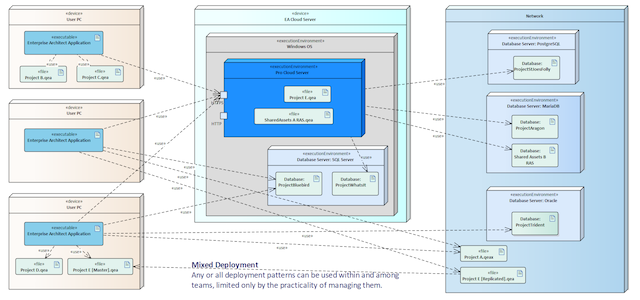
The EA Deployment Playbook is intended to help small teams understand their options when it comes to sharing a model repository using Sparx Enterprise Architect. It tackles configuration and typical growth paths from solo modeler to small teams.
This is not a book about UML modeling, instead it deals with the sometimes messy work of setting up a repository that is available to the team, and performs well when accessed simultaneously by multiple users. Additionally, it describes features unlocked by use of Sparx Pro-Cloud Server; how to configure the AI-assistant, and even touches on how to structure a repository and how to set up the security layer.
This book contains no mystical arcana. It simply pulls together, into one place, information that can otherwise take days to find; and organizes it such that setting up your deployment is a step-by-step affair.
The EA Deployment Handbook is available in multiple formats.
| Format | Description | Where to get it |
|---|---|---|
| Hardcover | Premium Paper, larger print, with full-color diagrams; 253 pages | https://www.amazon.com/Deployment-Playbook-Enterprise-Architect-Power-Users/dp/B0GVY15LSC/ |
| Softcover | Standard Paper with B&W diagrams; 202 pages | https://www.amazon.com/Deployment-Playbook-Enterprise-Architect-Power-Users/dp/B0GSMYV8C1/ |
| eBook - Kindle | color diagrams | https://www.amazon.com/Deployment-Playbook-Enterprise-Architect-Power-Users-ebook/dp/B0GSKXPR7T/ |
| eBook - epub | color diagrams | https://leanpub.com/ea-playbook |
BONUS: There are downloadable examples from the book available at github that you can use in your own deployment.